
Reading to interpret diagrams, maps and sketches.
Read and interpret diagrams and maps accurately;
Make meaning from spatial description/ Presentation; and
Identify how a given diagram or map clarifies/complements written material.
Reading to understand the author‘s mood.
Identify the author‘s mood through use of words and expressions;
Read between lines with a view to detecting hidden attitude; and
Identify the general impression created by the author‘s manner of presentation.
Reading to understand the author‘s mood.
Identify the author‘s mood through use of words and expressions;
Read between lines with a view to detecting hidden attitude; and
Identify the general impression created by the author‘s manner of presentation.
Reading for main and supporting ideas

Identify main and supporting ideas in a ideas from a given passage; and
Differentiate between main and supporting ideas from a given passage;
Reading for maximum retention and recall (intensive reading)

Preview passages;
Read carefully a given passage;
Recall salient points in a given passage;
Review the passage.
Reading for maximum retention and recall (intensive reading)
Preview passages;
Read carefully a given passage;
Recall salient points in a given passage;
Review the passage.
Consonant Sounds -[θ] and [ð]
At the end of the lesson, students should be able to pronounce words with sounds[θ] and [ð]
THE CONSONANT SOUND (t) and (d)
At the end of the lesson the student should be able to pronounce consonant sound (t) and (d) accurately.
Phonics – Consonant Sound /S/ and /z/
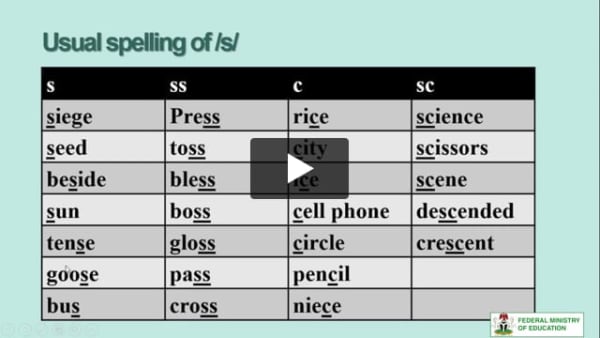
At the end of the lesson, students should be able to pronounce words with sounds /S/ and /Z/
THE CONSONANT SOUND (p) and (b)
At the end of the lesson the student should be able to pronounce vowel sounds (p) and (b) accurately.
Phonics /k/ – The Consonant Sound
At the end of the lesson, students should be able to pronounce words with sounds /k/
Phonics /i:/ and /I/
At the end of the lesson, students should be able to pronounce words with sounds /i:/ and /I/
THE CONSONANT SOUND (f) and (v)
At the end of the lesson the student should be able to pronounce consonant sound (f) and (v) accurately.
PHONICS vowel sound (e)
At the end of the lesson the student should be able to pronounce vowel sounds /e/ and /^/ accurately.
Phonics II
At the end of the lesson, students should be able to pronounce two to three syllable words correctly
Phonics Vowel sound /ae/ and /a:/
At the end of the lesson the student should be able to pronounce vowel sounds /ae/ and /a:/ accurately.
PHONICS Vowel sound
At the end of the lesson the student should be able to pronounce vowel sounds accurately.
The Vowel Sounds (au)
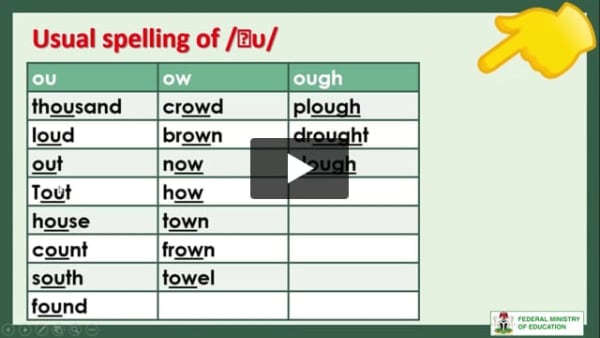
At the end of the lesson, students should be able to understand how to pronounce diphthongs (au)
The Vowel Sounds (ei)
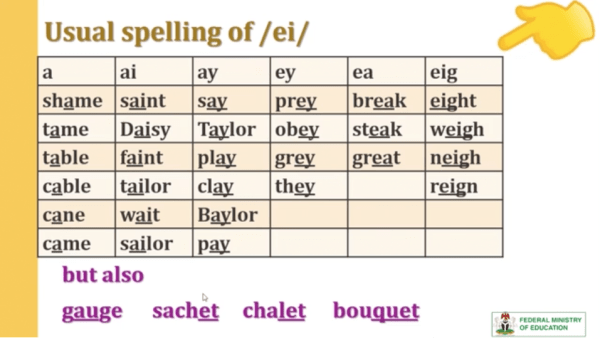
At the end of the lesson, students should be able to pronounce vowel diphthongs
The Vowel Sounds
At the end of the lesson, students should be able to pronounce vowel sounds