
Time
At the end of the lesson the student should be able to comprehend the concept time.
Length
At the end of the lesson the student should be able to comprehend the concept of length.
Weight
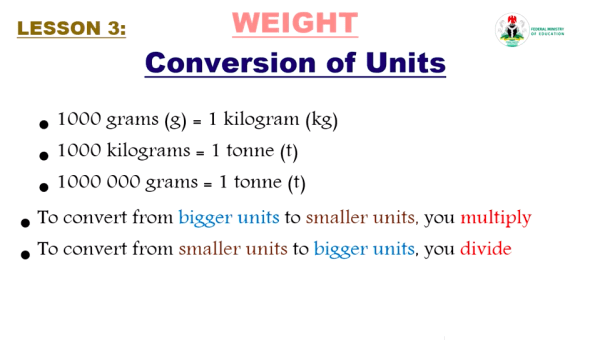
At the end of the lesson the student should be able to comprehend the concept of weight.
Weight
At the end of the lesson the student should be able to comprehend the concept of weight.
Money 2
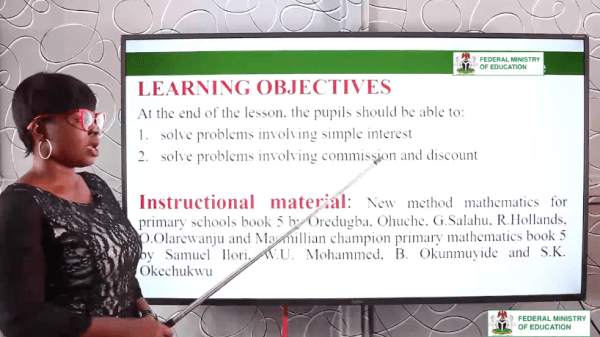
At the end of the lesson the student should be able to comprehend the concept of money and simple interest.
Money
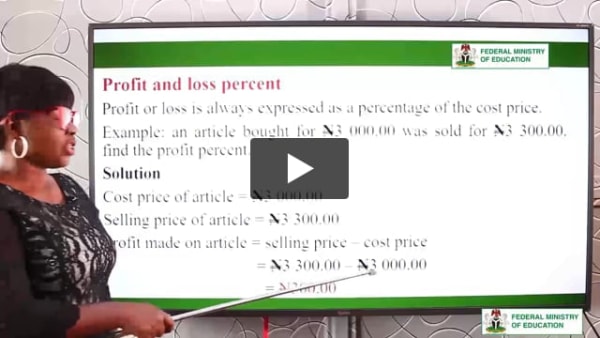
At the end of the lesson the student should be able to comprehend the concept of money.
Open Sentence
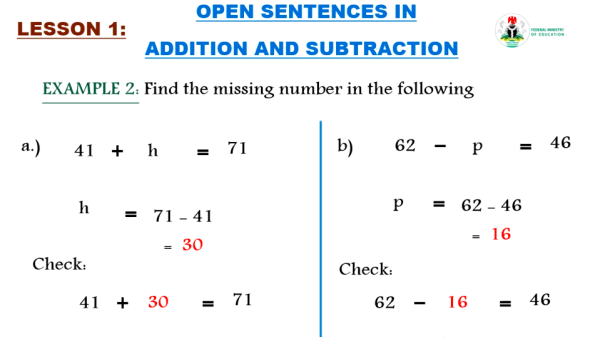
At the end of the lesson the student should be able to comprehend the concept of open sentence.
Estimation
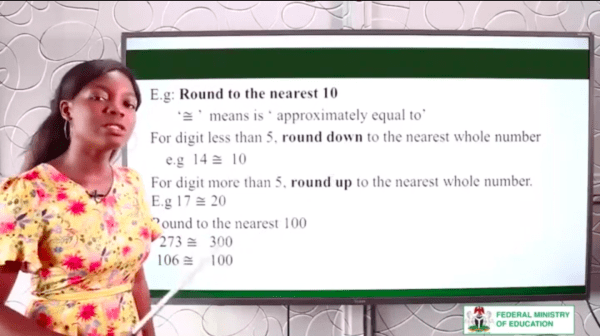
At the end of this lesson, the students should be able to understand Estimation
symmetry
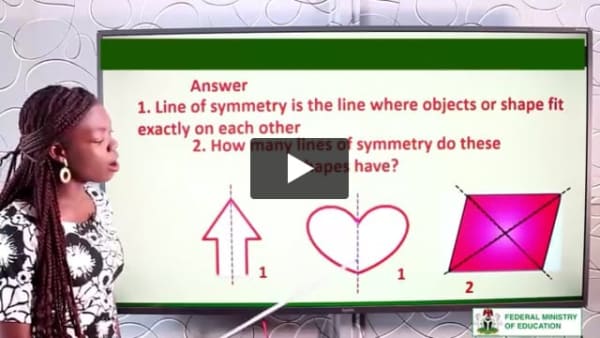
At the end of this lesson, the students should be able to understand symmetry
Probability

Understand the frequential, classical and axiomatic approach to probability
Define some terms used in probability (e.g random experiment, sample space, events e.t.c)
Solve problems on dependent and independent events
Solve problems on complements of events. Solve problems on conditional probability.
Understand and use probability trees in solving problems.
Conic section: the circle

Define a circle
Explain why circles can be regarded as a conic section
Find equations of a circle given radius and center
Find the equation of a tangent to the circle
Find length of tangent to circle from extended point
Differentiation (ii)

Find limits of a function at a given point
Differentiation from first principle
Differentiating polynomials
Differentiation of special functions like sin x, cos ax, ax
Use rules of differentiation
apply differentiation.
Differentiation (ii)

Find limits of a function at a given point
Differentiation from first principle
Differentiating polynomials
Differentiation of special functions like sin x, cos ax, ax
Use rules of differentiation
apply differentiation.
Differentiation(i)

Find limits of a function at a given point
Differentiation from first principle
Differentiating polynomials
Differentiation of special functions like sin x, cos ax, ax
Use rules of differentiation
apply differentiation.
Differentiation(i)

Find limits of a function at a given point
Differentiation from first principle
Differentiating polynomials
Differentiation of special functions like sin x, cos ax, ax
Use rules of differentiation
apply differentiation.
Binomial expansion

Construct the pascal triangle
Write out the binomial expansion for (a+b)n for positive integer, negative integers and fractional values
Apply the binomial expansion to evaluating the power of number e.g (1.06)
Binomial expansion
Construct the pascal triangle
Write out the binomial expansion for (a+b)n for positive integer, negative integers and fractional values
Apply the binomial expansion to evaluating the power of number e.g (1.06)
Trigonometry functions

Know the six important trigonometric functions of angles of any magnitude
Identify range and dimension of trigonometric ratios
Drawing of graphs of trigonometric ratios
Identifying relationships between graphs of trig ratios e.g sin x and sin 2x graphs
Inverse trigonometric ratios
Solution of equation of trigonometric ratios
Proof of simple trigonometric identities
Trigonometry functions

Know the six important trigonometric functions of angles of any magnitude
Identify range and dimension of trigonometric ratios
Drawing of graphs of trigonometric ratios
Identifying relationships between graphs of trig ratios e.g sin x and sin 2x graphs
Inverse trigonometric ratios
Solution of equation of trigonometric ratios
Proof of simple trigonometric identities
Polynomials
Define polynomials
Divide a polynomial by a polynomial of lesser degree
Use remainder theorem
Find factor of polynomials
Use roots of the cubic equation to solve a problem on cubic equations