
Measurement of Length and Mass
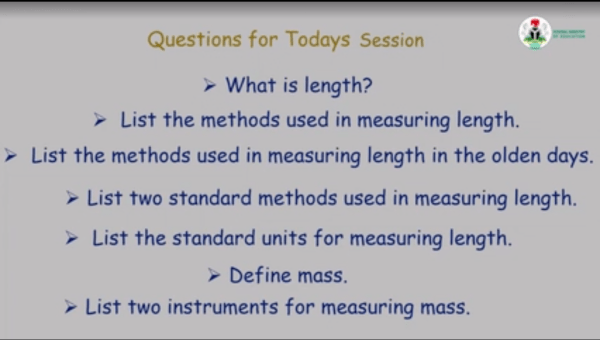
Measurement of Length and Mass – Learning about our environment
Measurement of Length and Mass
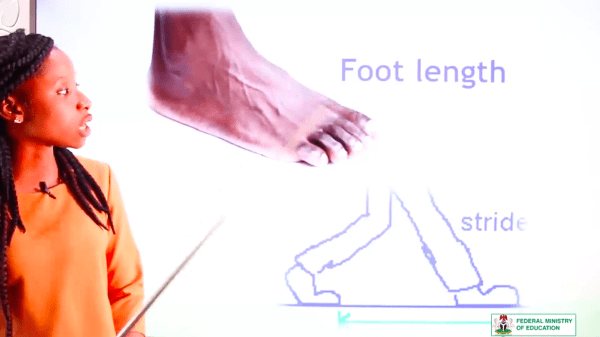
Measurement of Length and Mass – Learning about our environment
Particulate Nature of Matter

Students should be able to:
Formulate simple hypothesis and test them before they can draw conclusions based on specific information.
Explain how molecules of a substance move relative to other molecules of the same substance
Describe the atomic structure of matter
State the constituents of the atom
Use molecular theory to explain the three states of matter.
Describe the structure of simple crystals.
Distinguish between crystalline and amorphous substances
Use the concept of photon to explain that light behaves like particle.
Electric Field

Students should be
Able to:
Draw electric lines of force around:
Isolate positive charge; Isolate negative charge
Two like charges placed near each other two unlike charges placed near each other.
Generate a continuous flow of charge
Explain electric current.
Set up a simple electric circuit.
Distinguish between conductors and insulators
Define resistance as opposition to flow of charges (electrons).
Calculate the electrical work done in a given circuit.
Gravitational field.

Students should be able to:
Identify force fields from a set of forces.
Explain why two solid bodies of different masses released from rest at the same point simultaneously
fall to the ground at the same time.
Describe the shape of the earth.
Gravitational field.

Students should be able to:
Identify force fields from a set of forces.
Explain why two solid bodies of different masses released from rest at the same point simultaneously
fall to the ground at the same time.
Describe the shape of the earth.
Description and property of Fields

Students should be able to:
Identify force fields.
Identify the properyties of a force field.
Description and property of Fields

Students should be able to:
Identify force fields.
Identify the properyties of a force field.
Electric Charges.

Students should be able to:
Charge a body by friction, induction and contact.
Identify bodies charged either similarly or oppositely.
Electric Charges.

Students should be able to:
Charge a body by friction, induction and contact.
Identify bodies charged either similarly or oppositely.
Heat Energy
Students should be able to:
Explain. temperature,
Expansion, change of state, and vaporization using the kinetic Molecular Theory
Explain Conduction,
Convection and radiation in terms of the kinetic molecular theory.
Heat Energy

Students should be able to:
Explain. temperature,
Expansion, change of state, and vaporization using the kinetic Molecular Theory
Explain Conduction,
Convection and radiation in terms of the kinetic molecular theory.
Work, Energy and Power

Explain work, energy and power and give example of each
Calculate:
The workdone, given a force and displacement it produces in its direction.
The gravitational potential energy at a height h above a given reference plane
Calculate the lower in watts, given an applied force and the time it takes to produce a displacement.
Identify the type of energy possessed by a body under given conditions.
Distinguish between kinetic energy and potential energy
Identify energy transformation from one form into another
State the law of conservation of energy.
Work, Energy and Power

Explain work, energy and power and give example of each
Calculate:
The workdone, given a force and displacement it produces in its direction.
The gravitational potential energy at a height h above a given reference plane
Calculate the lower in watts, given an applied force and the time it takes to produce a displacement.
Identify the type of energy possessed by a body under given conditions.
Distinguish between kinetic energy and potential energy
Identify energy transformation from one form into another
State the law of conservation of energy.
Scalars and vectors
Distinguishing between scalar and vector quantities.
Speed and Velocity

distinguish between speed and velocity.
Plot a distancetime- graph and deduce the speed’ of motion from the gradient or slope of the graph.
Speed and Velocity
distinguish between speed and velocity.
Plot a distancetime- graph and deduce the speed’ of motion from the gradient or slope of the graph.
Motion

Defining motion
Classify a list of familiar motions into random, relational, oscillatory, and translational motion
Identifying the forces that cause a given body to move
Identifying which force or forces slow(s) down and finally stops a moving body.
Identifying a force resisting the motion between two surfaces in contact and moving relative to each other.
Reducing friction in a given situation.
Identifying circular motion.
Motion

Defining motion
Classify a list of familiar motions into random, relational, oscillatory, and translational motion
Identifying the forces that cause a given body to move
Identifying which force or forces slow(s) down and finally stops a moving body.
Identifying a force resisting the motion between two surfaces in contact and moving relative to each other.
Reducing friction in a given situation.
Identifying circular motion.
Time

Students should be able to construct a clock for measuring time interval or simple system that has a repetitive motion.