
Debtors and Creditors

Define Debtors
Define Creditors
Differentiate between debtor and creditor
Business Transactions

Explain business transaction
List different types of business transaction
Assets and liability

Define assests
Define liabilities
Differentiate between assets and liabilities
Classify assets and liabilities
Meaning of book keeping

Define book keeping
Narrate briefly the history of book keeping in Nigeria
Outline the importance of book keeping
Narrate the career opportunities in book keeping
List the beneficiaries of book keeping
Ecological Management: Association, Tolerance, Adaptation, Pollution
Describe reproduction in:
(i) Amoeba.
(ii) Paramecium,
(iii) Spirogyra.
Describe reproduction in:
(i) Earthworm.
(ii) Cockroach.
(iii) Housefly.
(iv) Snail.
Differentiate between complete and incomplete metamorphosis.
Ecological Management: Association, Tolerance, Adaptation, Pollution
Describe reproduction in:
(i) Amoeba.
(ii) Paramecium,
(iii) Spirogyra.
Describe reproduction in:
(i) Earthworm.
(ii) Cockroach.
(iii) Housefly.
(iv) Snail.
Differentiate between complete and incomplete metamorphosis.
Nutrient Cycling in Nature

Describe how carbon circulates in nature.
Draw the carbon cycle in detail.
State why the carbon cycle is necessary for life.
Recognise the delicate balance between carbon and oxygen.
Describe the part played by plants and animals in the water cycle.
Draw the water cycle in detail.
Describe with the aid of diagram the role of nitrogen.
State that energy can be obtained by a decomposing organic substance
Identify one of the gasses produced during decay.
Nutrient Cycling in Nature
Describe how carbon circulates in nature.
Draw the carbon cycle in detail.
State why the carbon cycle is necessary for life.
Recognise the delicate balance between carbon and oxygen.
Describe the part played by plants and animals in the water cycle.
Draw the water cycle in detail.
Describe with the aid of diagram the role of nitrogen.
State that energy can be obtained by a decomposing organic substance
Identify one of the gasses produced during decay.
Nutrient Cycling in Nature
Describe how carbon circulates in nature.
Draw the carbon cycle in detail.
State why the carbon cycle is necessary for life.
Recognise the delicate balance between carbon and oxygen.
Describe the part played by plants and animals in the water cycle.
Draw the water cycle in detail.
Describe with the aid of diagram the role of nitrogen.
State that energy can be obtained by a decomposing organic substance
Identify one of the gasses produced during decay.
Terrestrial Habitat (Arid Lands)
Recognise arid lands as places where water is not available to organisms because it is scarce or frozen.
Mention that sun, extremes of temperature, and water scarcity are factors that desert lives have to cope with.
Differentiate cold deserts (Tundra) from hot deserts (Sahara).
Adaptation of organisms to arid lands.
Terrestrial Habitat (Marsh)
Recognise types of marshes.
Correlate the effect of rainfall or any other source of
water and evaporation to the changes in a marsh.
Recognise the adaptations of organisms in marshy habitat
Appreciate the marsh as being transitional between aquatic and terrestrial habitat.
Aquatic habitat (Estuarine Habitat)

Describe the characteristics of marine habitats.
Describe the pattern of distribution of plants and animals in marine habitat, noting the dominant ones.
Recognise some adaptive features of the plants and animals in the habitats.
Infer the food chain of the organisms.
Determine some of the physical factors, e.g. temperature, relative humidity,light, wind and pH.
Towards better health

Describe some ways by which disease-causing microorganisms and infectious diseases can be controlled.
State ways of controlling vectors.
List ways of protecting ourselves from diseases caused by micro-organisms spread
by vectors.
Describe some methods used in the disposal of refuse and sewage.
State the roles the individuals should play to ensure good health
Name some national and international health organisation and provide some descriptions of what they do.
Micro-organisms in action
Recognise the presence of microbes by the colonies they form.
Measure the rate of growth of microbes.
List the beneficial effects of microbes from everyday experiences.
Recognise that some micro-organisms cause diseases.
Recognise that some disease-causing micro-organisms both air-borne and water-borne are spread through our food.
Relevance of Biology to Agriculture
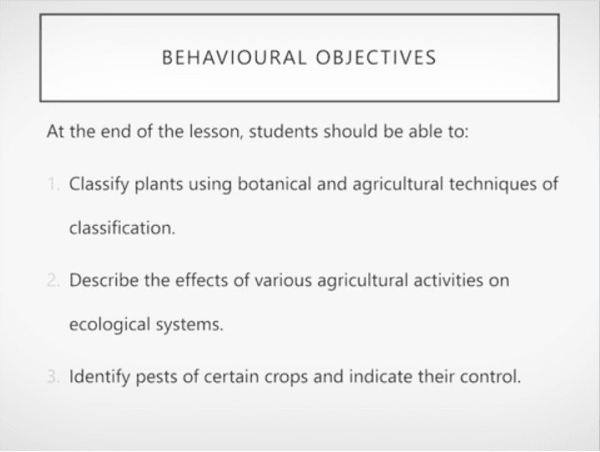
Classify plants using botanical and agricultural techniques of classification.
Describe the effects of various agricultural activities on ecological systems
Identify pests of certain crops and indicate their control.
Describe some common diseases caused by pests and their control.
Identify factors that affect the production of crops
Identify some methods of preserving and storing foodstuffs.
List the factors that
(i) affects population growth (ii) affects the availability of man’s food.
Relevance of Biology to Agriculture

Classify plants using botanical and agricultural techniques of classification.
Describe the effects of various agricultural activities on ecological systems
Identify pests of certain crops and indicate their control.
Describe some common diseases caused by pests and their control.
Identify factors that affect the production of crops
Identify some methods of preserving and storing foodstuffs.
List the factors that
(i) affects population growth (ii) affects the availability of man’s food.
Energy Transformation in Nature

Use the knowledge of energy losses in the ecosystem to explain the pyramidal shape of feeding relationships.
State that only a small percentage of the radiant energy actually gets to plants.
State the first and second laws of thermodynamics and use them to explain ecological events such as pyramid of energy, food chain and energy flow.
Functioning Ecosystem, Autotrophy and Heterotrophy – Food Webs and Tropic Levels

Define the terms autotrophy and heterotrophy.
Recognise that chemical energy (in the form of carbohydrates, fats, proteins) and nutrients are transferred among producers, consumers and decomposers.
State that trophic level refers to the parts of the food chain.
Correctly define (or describe) food chains and pyramid of energy/number.
Describe the nature of energy transfer or flow in the ecosystem.
State that there is a progressive diminution of energy in the feeding chain.
Recognise a definite change in the number of individuals from one feeding level to another, especially between producers and consumers.
Functioning Ecosystem, Autotrophy and Heterotrophy – Food Webs and Tropic Levels
Define the terms autotrophy and heterotrophy.
Recognise that chemical energy (in the form of carbohydrates, fats, proteins) and nutrients are transferred among producers, consumers and decomposers.
State that trophic level refers to the parts of the food chain.
Correctly define (or describe) food chains and pyramid of energy/number.
Describe the nature of energy transfer or flow in the ecosystem.
State that there is a progressive diminution of energy in the feeding chain.
Recognise a definite change in the number of individuals from one feeding level to another, especially between producers and consumers.
Basic Ecological Concepts

Name components of any ecosystem.
Measure or estimate sizes of some ecosystems.
Relate the dynamic nature of an ecosystem to its size.
Mention major local (Nigerian) biotic communities.
Give names of organisms typical of each community.
Briefly describe different types of communities in (a) tropical regions (b) temperate regions.
Name ecological factors common to all habitats.
Briefly describe each of the factors pointing out ‘their relative importance.
Mention the factors which affect water-retentivity of soil, types and determine the amount of water each soil type can hold.