
Relevance of Biology to Agriculture
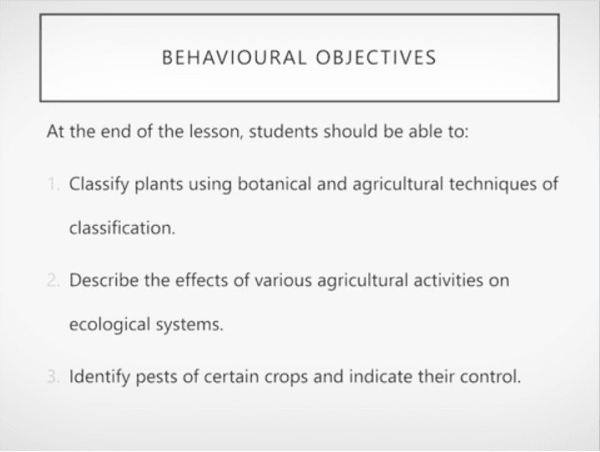
Classify plants using botanical and agricultural techniques of classification.
Describe the effects of various agricultural activities on ecological systems
Identify pests of certain crops and indicate their control.
Describe some common diseases caused by pests and their control.
Identify factors that affect the production of crops
Identify some methods of preserving and storing foodstuffs.
List the factors that
(i) affects population growth (ii) affects the availability of man’s food.
Relevance of Biology to Agriculture

Classify plants using botanical and agricultural techniques of classification.
Describe the effects of various agricultural activities on ecological systems
Identify pests of certain crops and indicate their control.
Describe some common diseases caused by pests and their control.
Identify factors that affect the production of crops
Identify some methods of preserving and storing foodstuffs.
List the factors that
(i) affects population growth (ii) affects the availability of man’s food.
Energy Transformation in Nature
Use the knowledge of energy losses in the ecosystem to explain the pyramidal shape of feeding relationships.
State that only a small percentage of the radiant energy actually gets to plants.
State the first and second laws of thermodynamics and use them to explain ecological events such as pyramid of energy, food chain and energy flow.
Functioning Ecosystem, Autotrophy and Heterotrophy – Food Webs and Tropic Levels

Define the terms autotrophy and heterotrophy.
Recognise that chemical energy (in the form of carbohydrates, fats, proteins) and nutrients are transferred among producers, consumers and decomposers.
State that trophic level refers to the parts of the food chain.
Correctly define (or describe) food chains and pyramid of energy/number.
Describe the nature of energy transfer or flow in the ecosystem.
State that there is a progressive diminution of energy in the feeding chain.
Recognise a definite change in the number of individuals from one feeding level to another, especially between producers and consumers.
Functioning Ecosystem, Autotrophy and Heterotrophy – Food Webs and Tropic Levels
Define the terms autotrophy and heterotrophy.
Recognise that chemical energy (in the form of carbohydrates, fats, proteins) and nutrients are transferred among producers, consumers and decomposers.
State that trophic level refers to the parts of the food chain.
Correctly define (or describe) food chains and pyramid of energy/number.
Describe the nature of energy transfer or flow in the ecosystem.
State that there is a progressive diminution of energy in the feeding chain.
Recognise a definite change in the number of individuals from one feeding level to another, especially between producers and consumers.
Basic Ecological Concepts

Name components of any ecosystem.
Measure or estimate sizes of some ecosystems.
Relate the dynamic nature of an ecosystem to its size.
Mention major local (Nigerian) biotic communities.
Give names of organisms typical of each community.
Briefly describe different types of communities in (a) tropical regions (b) temperate regions.
Name ecological factors common to all habitats.
Briefly describe each of the factors pointing out ‘their relative importance.
Mention the factors which affect water-retentivity of soil, types and determine the amount of water each soil type can hold.
Basic Ecological Concepts
Name components of any ecosystem.
Measure or estimate sizes of some ecosystems.
Relate the dynamic nature of an ecosystem to its size.
Mention major local (Nigerian) biotic communities.
Give names of organisms typical of each community.
Briefly describe different types of communities in (a) tropical regions (b) temperate regions.
Name ecological factors common to all habitats.
Briefly describe each of the factors pointing out ‘their relative importance.
Mention the factors which affect water-retentivity of soil, types and determine the amount of water each soil type can hold.
Nutrition in Animals
Define what food substances are.
List types of food substances and state what makes a balanced diet is.
List types of heterotrophic nutrition and feeding mechanisms in holozoic organisms.
(I) List types of mammalian teeth.
(ii) Describe the structure of a mammalian tooth.
(iii) State the dental formula and adaptations of dentition to mode of nutrition.
Describe digestion in Amoeba, Earthworm, Cockroach, grasshopper and birds.
Nutrition in Animals
Define what food substances are.
List types of food substances and state what makes a balanced diet is.
List types of heterotrophic nutrition and feeding mechanisms in holozoic organisms.
(I) List types of mammalian teeth.
(ii) Describe the structure of a mammalian tooth.
(iii) State the dental formula and adaptations of dentition to mode of nutrition.
Describe digestion in Amoeba, Earthworm, Cockroach, grasshopper and birds.
Nutrition in Animals
Define what food substances are.
List types of food substances and state what makes a balanced diet is.
List types of heterotrophic nutrition and feeding mechanisms in holozoic organisms.
(I) List types of mammalian teeth.
(ii) Describe the structure of a mammalian tooth.
(iii) State the dental formula and adaptations of dentition to mode of nutrition.
Describe digestion in Amoeba, Earthworm, Cockroach, grasshopper and birds.
Tissues and Supporting Systems
Recognise different skeletal and supporting tissues.
State the location and arrangement of skeletal and supporting tissues in animals.
State the different supporting tissues (turgid parenchyma, collenchyma, xylem (wood) sclerenchyma) in plants, and the arrangement of these supporting tissues.
State the functions of skeleton and supporting tissues in animals and plants and how these functions are performed.
Construct a working model of a human arm and explain how it functions
Tissues and Supporting Systems
Recognise different skeletal and supporting tissues.
State the location and arrangement of skeletal and supporting tissues in animals.
State the different supporting tissues (turgid parenchyma, collenchyma, xylem (wood) sclerenchyma) in plants, and the arrangement of these supporting tissues.
State the functions of skeleton and supporting tissues in animals and plants and how these functions are performed.
Construct a working model of a human arm and explain how it functions
Some Properties and ‘Functions of the Cell
Recognise that some nutrients (micronutrients) are needed in small qualities while others (macronutrients) are needed in large quantities
Show experimental that the break-down of carbohydrates may be partial (fermentation) or complete
Recognise that cells require proteins, fats and carbohydrates for the production of new protoplasm, for repair, growth and provision of energy
Recognise that certain cells are autotrophic and others are heterotrophic
Discuss the role of enzymes in digestion
Infer that excretion is the removal of metabolic waste products from the cell which may be toxic or which are in excess of the cell needs. removal of waste products is by diffusion through the body contractile vacuole.
Identify growth as
(i) increase in dry weight
(ii) irreversible increase in size and length
(iii) increase in number of cells
Demonstrate by experiments factors that affect growth.
Explain ability of cell to detect and respond to external stimuli.
Identity structural adaptations for mobility e.g. Cilla and flagella.
Recognise reproduction as the ability of living things to produce new individuals of their type
Some Properties and ‘Functions of the Cell
Recognise that some nutrients (micronutrients) are needed in small qualities while others (macronutrients) are needed in large quantities
Show experimental that the break-down of carbohydrates may be partial (fermentation) or complete
Recognise that cells require proteins, fats and carbohydrates for the production of new protoplasm, for repair, growth and provision of energy
Recognise that certain cells are autotrophic and others are heterotrophic
Discuss the role of enzymes in digestion
Infer that excretion is the removal of metabolic waste products from the cell which may be toxic or which are in excess of the cell needs. removal of waste products is by diffusion through the body contractile vacuole.
Identify growth as
(i) increase in dry weight
(ii) irreversible increase in size and length
(iii) increase in number of cells
Demonstrate by experiments factors that affect growth.
Explain ability of cell to detect and respond to external stimuli.
Identity structural adaptations for mobility e.g. Cilla and flagella.
Recognise reproduction as the ability of living things to produce new individuals of their type
Some Properties and ‘Functions of the Cell

Recognise that some nutrients (micronutrients) are needed in small qualities while others (macronutrients) are needed in large quantities
Show experimental that the break-down of carbohydrates may be partial (fermentation) or complete
Recognise that cells require proteins, fats and carbohydrates for the production of new protoplasm, for repair, growth and provision of energy
Recognise that certain cells are autotrophic and others are heterotrophic
Discuss the role of enzymes in digestion
Infer that excretion is the removal of metabolic waste products from the cell which may be toxic or which are in excess of the cell needs. removal of waste products is by diffusion through the body contractile vacuole.
Identify growth as
(i) increase in dry weight
(ii) irreversible increase in size and length
(iii) increase in number of cells
Demonstrate by experiments factors that affect growth.
Explain ability of cell to detect and respond to external stimuli.
Identity structural adaptations for mobility e.g. Cilla and flagella.
Recognise reproduction as the ability of living things to produce new individuals of their type
The Cell and its Environment: Osmosis

Demonstrate diffusion and osmosis experimentally
Recognise that osmosis is a form of diffusion
Recognise that plasmolysis can lead to wilting and haemolysis can lead to loss of blood
The Cell and its Environment: Osmosis

Demonstrate diffusion and osmosis experimentally
Recognise that osmosis is a form of diffusion
Recognise that plasmolysis can lead to wilting and haemolysis can lead to loss of blood
The Cell and its Environment: Osmosis
Demonstrate diffusion and osmosis experimentally
Recognise that osmosis is a form of diffusion
Recognise that plasmolysis can lead to wilting and haemolysis can lead to loss of blood
The cell
Describe the general structure of a cell
Distinguish between free-living cells and colonies, filaments and tissues
Describe the general structure of a cell
Differentiate
between a plant and an
animal cell
The cell
Describe the general structure of a cell
Distinguish between free-living cells and colonies, filaments and tissues
Describe the general structure of a cell
Differentiate
between a plant and an
animal cell