Responsible Parenthood

Students should be able to: explain the meaning of responsible parenthood;
State and discuss the roles of responsible parents;
Explain the importance of responsible parenthood in national development.
Responsible Parenthood

Students should be able to: explain the meaning of responsible parenthood;
State and discuss the roles of responsible parents;
Explain the importance of responsible parenthood in national development.
Drug Law, Enforcement and Administration

Students should be able to identify some of the drug laws from government;
Describe some of the activities of drug law enforcement acencles,
Drug Law, Enforcement and Administration
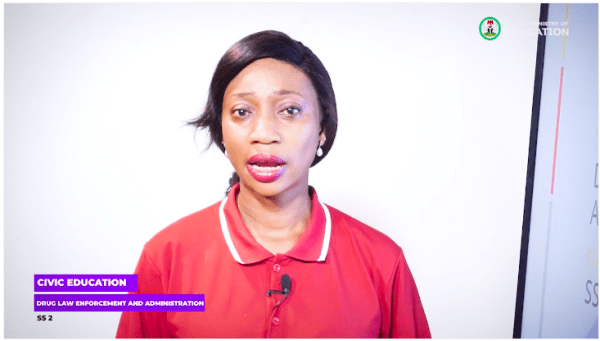
Students should be able to identify some of the drug laws from government;
Describe some of the activities of drug law enforcement acencles,
Prevention of Drug Abuse

Students should be able to: identify how drug abuse can be prevented;
List some of the government agencies working to prevent drug abuse
Effect of Drugs and Drug Abuse

Students should be able to: describe the symptoms of drug
Demonstrate some behaviours of an addict.
Drug Use and Abuse

Students should be able to: define drug and drug abuses.
Identify types of drugs and how they can be abused.
Human Rights

Student should be able to: define human rights;
Identify what may lead to limitations of human rights;
Describe what happens during emergency periods. .
Popular participation

Students should be able to:
Define popular participation in politics;
Give reasons why people do not non-participate in politics;
Describe how popular , organizations are formed.
Meaning and forms of aparthy

Students should be able to:
Define political apathy in its various forms.
Give reasons for political apathy;
Explain why leaders fail to protect the interest of their followers.
Capitalist democracy
Student should be able to: define and explain capitalist democracy and its characteristics;
Describe how political parties compete for power through elections;
Explain how employment can alleviate poverty;
Describe what promotes guaranteed employment, free education, medical care etc.
Probability

Understand the frequential, classical and axiomatic approach to probability
Define some terms used in probability (e.g random experiment, sample space, events e.t.c)
Solve problems on dependent and independent events
Solve problems on complements of events. Solve problems on conditional probability.
Understand and use probability trees in solving problems.
Conic section: the circle

Define a circle
Explain why circles can be regarded as a conic section
Find equations of a circle given radius and center
Find the equation of a tangent to the circle
Find length of tangent to circle from extended point
Differentiation (ii)

Find limits of a function at a given point
Differentiation from first principle
Differentiating polynomials
Differentiation of special functions like sin x, cos ax, ax
Use rules of differentiation
apply differentiation.
Differentiation (ii)

Find limits of a function at a given point
Differentiation from first principle
Differentiating polynomials
Differentiation of special functions like sin x, cos ax, ax
Use rules of differentiation
apply differentiation.
Differentiation(i)

Find limits of a function at a given point
Differentiation from first principle
Differentiating polynomials
Differentiation of special functions like sin x, cos ax, ax
Use rules of differentiation
apply differentiation.
Differentiation(i)

Find limits of a function at a given point
Differentiation from first principle
Differentiating polynomials
Differentiation of special functions like sin x, cos ax, ax
Use rules of differentiation
apply differentiation.
Binomial expansion

Construct the pascal triangle
Write out the binomial expansion for (a+b)n for positive integer, negative integers and fractional values
Apply the binomial expansion to evaluating the power of number e.g (1.06)
Binomial expansion
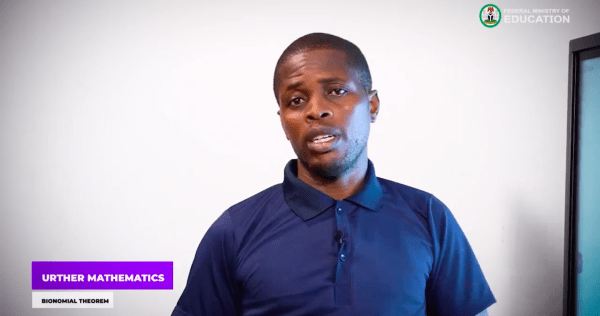
Construct the pascal triangle
Write out the binomial expansion for (a+b)n for positive integer, negative integers and fractional values
Apply the binomial expansion to evaluating the power of number e.g (1.06)
Trigonometry functions

Know the six important trigonometric functions of angles of any magnitude
Identify range and dimension of trigonometric ratios
Drawing of graphs of trigonometric ratios
Identifying relationships between graphs of trig ratios e.g sin x and sin 2x graphs
Inverse trigonometric ratios
Solution of equation of trigonometric ratios
Proof of simple trigonometric identities